The National Committee on Urban Growth Policy and the Title VII New Communities Program
The National Committee on Urban Growth Policy (NCUGP), active from 1967 to 1969, represented one of the most ambitious federal efforts to articulate a coherent national strategy for managing metropolitan expansion in the United States.¹ Its work emerged during a period of intense concern about suburban sprawl, central‑city decline, and the fiscal and environmental consequences of uncoordinated growth.² The Committee’s reports emphasized the need for federal leadership in shaping metropolitan form, recommending a combination of growth management, regional planning, and the creation of new communities as alternatives to uncontrolled suburbanization.³
The NCUGP’s recommendations directly influenced the development of the New Communities Act of 1968, which authorized federal guarantees to support large‑scale, comprehensively planned developments intended to absorb population growth and provide balanced, mixed‑income environments.⁴ Although the 1968 program was modest in scale, it established the conceptual and administrative foundation for the more robust Title VII New Communities Program, enacted as part of the Housing and Urban Development Act of 1970.⁵
Title VII represented the most significant federal intervention in the planning and financing of new towns in U.S. history.⁶ It offered federal loan guarantees covering up to 75 percent of development costs for projects that met stringent criteria for scale, planning quality, environmental stewardship, and social balance.⁷ HUD envisioned these communities as instruments of metropolitan restructuring—places that could relieve growth pressures, provide alternatives to sprawl, and demonstrate innovative planning and development practices.⁸
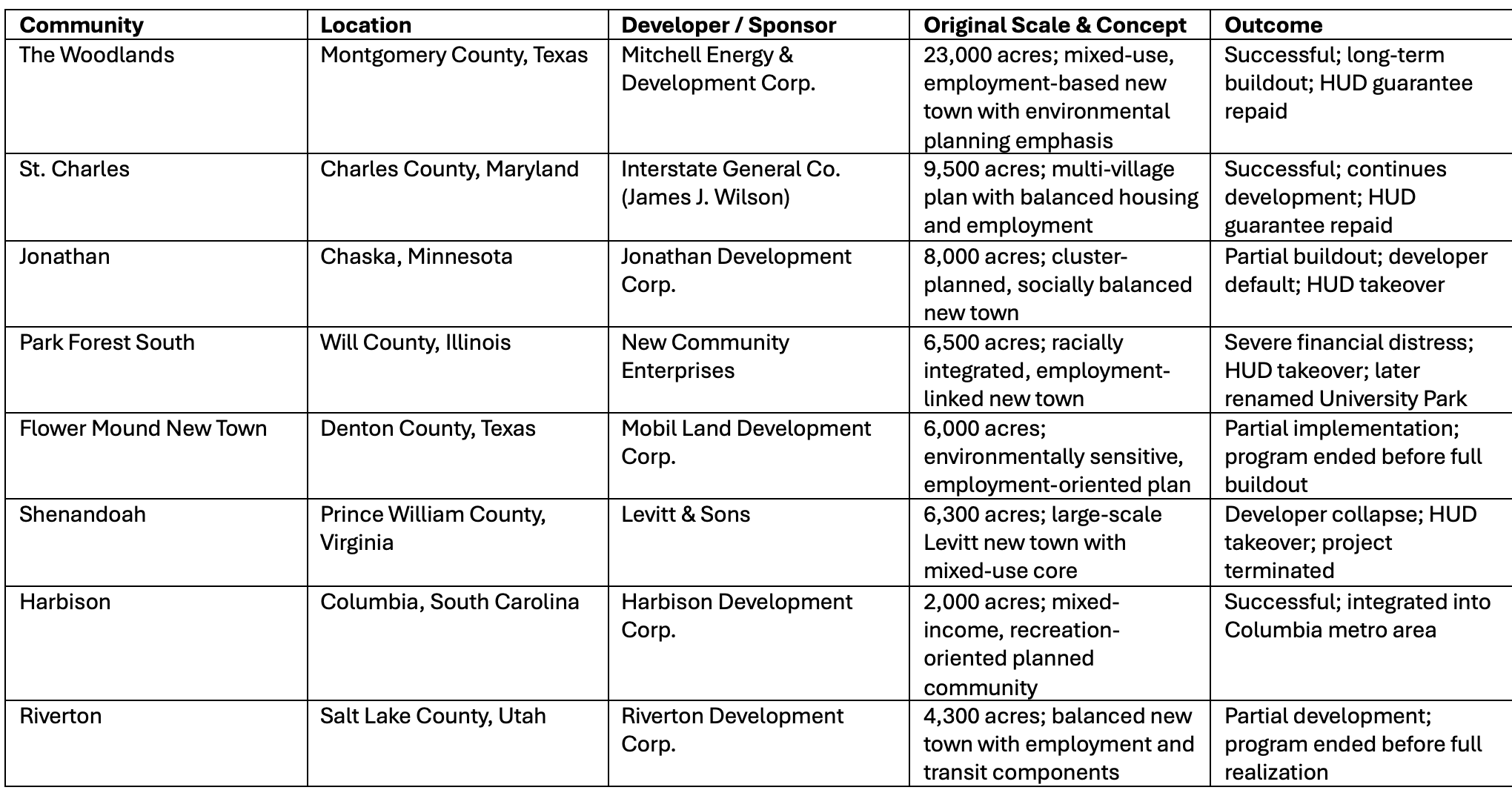
Despite its ambition, the Title VII program faced substantial challenges. The economic downturn of the mid‑1970s, high interest rates, and the collapse of several major developers undermined the financial viability of many projects.⁹ HUD ultimately assumed control of multiple communities after developer defaults, and the program was terminated in 1978.¹⁰ Nevertheless, several Title VII communities—most notably The Woodlands (TX) and St. Charles (MD)—achieved long‑term success and continue to be cited as influential examples of large‑scale master planning.¹¹
The NCUGP’s broader legacy lies in its articulation of a national growth policy framework, which influenced subsequent federal, state, and regional planning initiatives.¹² Although the United States never adopted a formal national urban growth policy, the Committee’s work helped shape debates about metropolitan governance, environmental planning, and the role of the federal government in guiding urban development.¹³ The Title VII program, while short‑lived, demonstrated both the potential and the limitations of federal involvement in large‑scale community development.¹⁴
Major Title VII New Communities (1970–1978)
Footnotes
National Committee on Urban Growth Policy, Urban Growth Policy in the United States (Washington, DC: U.S. Government Printing Office, 1969), 1–3.
Ibid., 5–7.
National Committee on Urban Growth Policy, A National Urban Growth Policy: Summary Report (Washington, DC: U.S. Government Printing Office, 1969), 12–18.
U.S. Congress, New Communities Act of 1968, Pub. L. 90‑448, Title IV, 82 Stat. 476.
U.S. Congress, Housing and Urban Development Act of 1970, Pub. L. 91‑609, Title VII, 84 Stat. 1784.
U.S. Department of Housing and Urban Development, New Communities Program: Annual Report 1972 (Washington, DC: HUD, 1973), 3–5.
Ibid., 10–12.
U.S. Department of Housing and Urban Development, New Communities: Program Guide (Washington, DC: HUD, 1972), 4–6.
U.S. Government Accountability Office, The Federal New Communities Program: A Preliminary Assessment (Washington, DC: GAO, 1976), 7–9.
U.S. Government Accountability Office, The Federal New Communities Program: Final Report (Washington, DC: GAO, 1979), 1–4.
Robert Fishman, Urban Utopias in the Twentieth Century (Cambridge, MA: MIT Press, 1982), 201–205.
Peter Hall, Cities of Tomorrow, 4th ed. (Oxford: Wiley‑Blackwell, 2014), 322–325.
Ann Forsyth, “New Towns for the Twenty‑First Century: A Reconsideration,” Journal of the American Planning Association 68, no. 3 (2002): 287–289.
Fishman, Urban Utopias, 205–207.
U.S. Department of Housing and Urban Development, New Communities Program: Annual Report 1974 (Washington, DC: HUD, 1975), 22–25.
Ibid., 30–33.
GAO, Preliminary Assessment, 15–17.
GAO, Final Report, 12–14.
HUD, Annual Report 1974, 40–42.
Ibid., 45–47.
HUD, New Communities: Program Guide, 18–20.
GAO, Final Report, 20–22.