By H. Pike Oliver and C. Michael Stockstill
In late August 2023, a New York Times story answered a question that had been circulating among ranchers, farmers, and other Solano County residents for months: Who was buying thousands of acres of land near Travis Air Force Base? (Dougherty & Griffith, 2023).
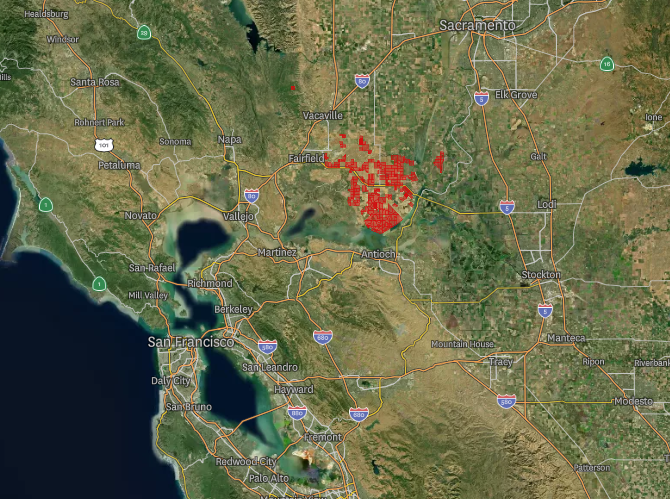
Source: San Francisco Chronicle Solano Land Map (Neilson & Stiefel, 2023). The map highlights land controlled by Flannery Associates as of 2023 in red.
The article revealed that Flannery Associates made the land purchases. More significantly, prominent Bay Area technology billionaires backed the company, including Marc Andreessen (co-founder of Netscape), Reid Hoffman (co-founder of LinkedIn), Laurene Powell Jobs (founder of Emerson Collective and the widow of Apple founder Steve Jobs), and Michael Moritz (founder of Sequoia Capital).
Jan Sramek, who worked as a Goldman Sachs trader for eighteen months beginning in 2009, then founded two educational startups from 2011 through 2016, recruited these and other billionaires to fund an ambitious vision (Sramek, n.d.). In the months that followed the New York Times story, California Forever outlined plans for an entirely new city on 17,500 acres of the more than 60,000 acres it had acquired since 2017.
Located in southeastern Solano County, California, about 42 miles southeast of downtown Sacramento and 65 miles northwest of downtown San Francisco, the proposed city site lies between Fairfield and Suisun City to the west and Rio Vista to the east. The proposed multidecade master-planned community is intended to eventually accommodate up to 400,000 residents.
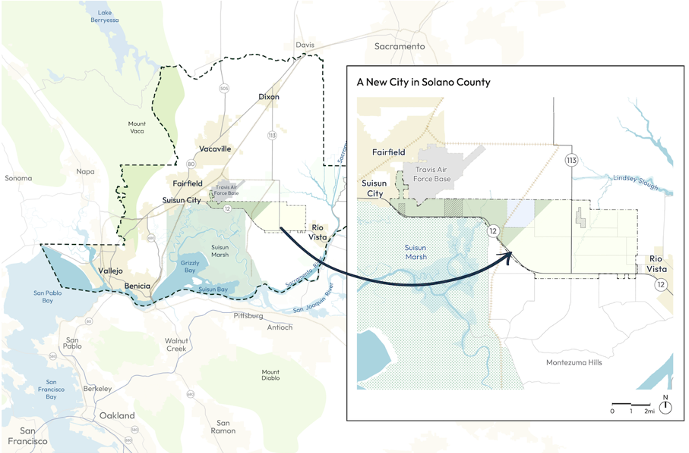
Source: California Forever (California Forever, n.d.-a)
California Forever faced a significant trust challenge from the outset, largely because it struggled to transition from land acquisition to community planning and regulatory processing. The project soon encountered challenges like those faced by Southern California's premier master-planned community on the Irvine Ranch more than half a century earlier (Oliver & Stockstill, 2026).
The comparison also highlights an important difference in their starting points. When planning for the Irvine Ranch's transformation began in 1960, the Irvine Company had controlled the land for nearly a century and had just transferred 990 acres to the University of California for $1, creating a major institutional anchor around which a new community could be planned (Irvine Historical Society, n.d.; University of California, Irvine, n.d.).
California Forever, by contrast, first had to assemble the land needed for its vision. That process began only six years before the project became public and was conducted confidentially, with good reason, to avoid land speculation, holdouts, and escalating acquisition costs. Yet the same secrecy that facilitated the land assembly also fueled the suspicion California Forever faced when it moved into public planning in 2023.
The Irvine Company also benefited from an unusual institutional relationship. The University of California required an integrated planning concept for land surrounding the new campus, encouraging planning for the university and future community as interdependent elements. The Irvine Company's initial ranch-wide plan remained a private planning framework rather than an adopted governmental plan; jurisdictional adoption followed incrementally, beginning with county approval of the South Irvine Ranch General Plan in 1964 (Irvine Historical Society, n.d.; University of California, Irvine, n.d.)
Over its first three years in public view, California Forever has faced a challenge familiar to other large-scale master-planned communities: translating private land control and a detailed planning vision into jurisdictional adoption. The company abandoned its initial effort to secure a major General Plan amendment through a countywide election in July 2024 and has since pursued other governmental and municipal pathways. It has yet to obtain the principal land-use approvals needed to implement the new community.
The first three years
The following chronology traces the California Forever proposal from August 2023 through August 2026.
August 2023 - Public disclosure began with a trust challenge
Critics raised concerns about environmental and infrastructure impacts, growth management, and the company’s relationships with certain farmers and residents (Wong, 2004). After identifying the previously anonymous investors, California Forever articulated its vision for the new city.
The confidential acquisition strategy was likely rational and perhaps essential. Had the sponsors announced their intentions at the outset, they likely would have triggered land speculation, fragmented ownership, and increased holdout behavior, driving acquisition costs substantially higher. Interestingly, the developer of Columbia, Maryland, one of North America's most revered master-planned communities, used a similar land-acquisition approach in the 1960s (Rosenthal, 1971).
The bigger issue was that once the project became public, landowners, local governments, environmental organizations, and other regional interests often viewed it through the lens of prior landowner conflicts and litigation, and with skepticism about the motivations and influence of the project's billionaire investors. Combined with the perception that the investor group had made key decisions before meaningful local engagement, these concerns turned the project's first public chapter into a debate over trust and transparency, more than planning and development (Wong, 2024).
Early 2024 - An ambitious initiative sparked debate
California Forever advanced the East Solano Plan as a countywide ballot initiative. The proposal included extensive commitments to housing, employment, infrastructure investment, and community benefits. However, legal experts and local officials questioned whether some of the project's proposed guarantees were enforceable (Sumagaysay & Christopher, 2024).
At the same time, county review materials addressing water, traffic, habitat, fiscal effects, infrastructure, and impacts on surrounding municipalities were still being assembled (Solano County Registrar of Voters, n.d.). As a result, voters and elected officials were asked to evaluate a very large concept before many supporting technical questions had been fully addressed.
Supporters and critics viewed the initiative differently. California Forever argued that voter authorization was necessary to advance a project of this scale and establish a pathway for more detailed environmental review and implementation planning. Critics argued that voters were being asked to approve a major General Plan amendment before many of the project's environmental, infrastructure, fiscal, and governance questions had been fully addressed.
Summer 2024 - Ballot measure withdrawn
In July 2024, California Forever withdrew the ballot measure despite having qualified it for the November election. California Forever said it would work with the county on an Environmental Impact Report and Development Agreement before resubmitting it for approval (Cooke, 2024; Sierra & ABC7 Bay Area Digital Staff, 2024).
The withdrawal reset the approval process. Environmental analysis, negotiations over development terms, and governmental review would now precede another effort to secure major land-use approvals. The change also created an opportunity for California Forever to refine the project, address documented impacts, negotiate enforceable commitments, and build broader local and regional support.
Late summer and fall 2024 - A somewhat contentious reset
After withdrawing the initiative, California Forever publicly urged the county to establish a clear schedule for processing its application and moving toward a future vote. The company argued that California’s legally required planning processes would move faster if it focused on building rather than prolonged planning (California Forever, 2024).
Seeking certainty and predictability was understandable. A project with significant capital commitments cannot operate indefinitely without a reasonably defined review schedule. The problem was that the company’s continued emphasis on speed risked reinforcing concerns that it viewed planning and environmental review primarily as obstacles to approval rather than essential parts of project development and public decision-making.
At the same time, the company increasingly focused on local jurisdictions, existing planning processes, and potential municipal partnerships. In effect, the question shifted from whether Solano County voters would authorize a new city to how and under what conditions an existing city might accommodate future expansion.
This marked a significant strategic transition. Rather than seeking approval through a countywide ballot initiative, California Forever began moving toward a municipal-based approach centered on local government partnerships, established planning procedures, and the possibility of expanding an existing city's boundaries. That shift would ultimately shape the project's next phase.
2024–2025 - Relationships with nearby municipalities and the county
California Forever devoted considerable effort to cultivating a relationship with Suisun City, but it never achieved comparable alignment with Rio Vista. For a project that would transform southeastern Solano County, that imbalance mattered because residents often viewed Rio Vista as one of the communities most directly affected by the proposal.
During the 2024 East Solano Plan ballot initiative process, Rio Vista submitted comments on the East Solano Plan initiative proposed by California Forever and raised concerns about project impacts, noting that important issues remained unresolved (Solano County Registrar of Voters, n.d.).
As the ballot strategy gave way to other potential development pathways, including possible annexation to an existing city, an awkward regional dynamic emerged. California Forever explored alternative approval mechanisms before building a broad coalition among the jurisdictions most affected by the proposal.
Solano County leadership was divided. Rio Vista appeared cautious or skeptical. Fairfield and several other Solano County cities, including Benicia, Vacaville, and Vallejo, submitted concerns about potential impacts (Solano County Registrar of Voters, n.d.). Suisun City became a more significant institutional relationship. State officials became increasingly involved in implementation discussions and efforts to accelerate the project.
For a project of regional significance, this mattered. Large-scale developments require not only legal approvals but durable community and governmental relationships. California Forever arguably needed a southeast Solano coalition strategy as much as it needed a development and entitlement strategy.
The central question was not simply whether California Forever had identified a viable annexation or municipal-growth pathway. The more important question was which of the local governments believed they were genuine partners in shaping the project’s future.
2025 - Branding expanded beyond a new city
In 2025, California Forever gave greater prominence to the manufacturing and industrial components of its vision by naming it the Solano Foundry. This clearly identified it as a manufacturing district targeting sectors such as robotics, logistics, transportation, aerospace, energy, and defense. In March, it also proposed a major shipyard near Collinsville, introducing a significant maritime-industrial component absent from the project's earlier public narrative (Bandlamudi, 2025; California Forever, n.d.-b).
These refinements strengthened the economic-development rationale by linking the project to industrial employment, national-security-related manufacturing, and broader regional economic growth. Housing, manufacturing, and shipbuilding could reinforce one another by placing homes closer to employment centers and providing industrial employers with access to a larger labor force.
Reviewers were now asked to evaluate not only a new city but also an advanced manufacturing complex and a major maritime-industrial development. The evolving narrative made it harder to determine what was being proposed, which components depended on one another, and what environmental, infrastructure, and governance analyses each component would require. It also raised questions about whether to evaluate all elements of the proposal as a single integrated vision or as distinct projects on separate tracks.
2025–2026 - Shipyard initiative strained state-local collaboration
Public reporting subsequently showed that California Forever representatives pressed county officials to support legislation intended to expedite aspects of the shipyard proposal under tight time constraints. County officials complained that legislative language was unavailable or incomplete when they were asked for support (Wolffe & Yu, 2026a).
The proposed measures included accelerated environmental procedures and shorter periods for legal challenges. These measures could have significantly affected the county’s administrative responsibilities, environmental oversight, litigation exposure, and stakeholder relationships.
More importantly, several county officials said they were not being treated as full partners in discussions involving California Forever, members of Governor Gavin Newsom’s staff, and other state-level participants. Supervisors' public comments expressed frustration that Solano County was being asked to respond to proposals whose basic contours had already been developed elsewhere (Wolffe & Yu, 2026a).
Whether every aspect of that perception was justified is less important than the fact that it existed. For a project that depends on county cooperation over many years, local officials need to believe they are helping shape decisions, not merely reviewing or ratifying them. By the time the shipyard legislation reached public consideration, substantial disagreement remained over whether that condition had been met. One supervisor’s description of state officials treating county officials as “toddlers in the room” suggested that local participation had been more limited than county leaders believed it should have been (Dutta Gupta, 2026; Wolffe & Yu, 2026b).
This issue connected to a broader pattern that colored the project’s history. Several stakeholders seemed uncertain whether they were being invited to shape the vision or simply approve it after key decisions had already been made without their input (Solano County Registrar of Voters, n.d.; Wolffe & Yu, 2026a; Wong, 2024).
August 2026 - Shipyard fast-track effort stalled
By August 2026, California Forever had increasingly turned to state legislation. The company retained former California Legislature leaders Darrell Steinberg and Bob Hertzberg to advance elements of its shipyard and manufacturing agenda. The legislation sought to accelerate project review and implementation. To critics, the move reinforced concerns that the project was pursuing alternative approval pathways before building broader local consensus (Dutta Gupta, 2026; Wolffe & Yu, 2026b).
On August 25, 2026, the Solano County Board of Supervisors voted 3–2 against supporting the proposed Solano Maritime and Manufacturing Act. The proposal would have allowed approximately 1,350 acres of maritime and manufacturing development to rely on an older county environmental report instead of undergoing a new, project-specific review (Wolffe & Yu, 2026b).
Supervisors cited concerns about the rushed process, placing environmental responsibilities on the county, and excluding or insufficiently involving certain labor and tribal stakeholders. The vote effectively ended the 2026 legislative effort, though some supervisors said they could reconsider a revised proposal later (Wolffe & Yu, 2026b).
The outcome reflected a recurring pattern throughout the project. Resistance often stemmed less from categorical opposition to housing, manufacturing, or economic development than from concerns about process, timing, governance, environmental review, and stakeholder inclusion (Solano County Registrar of Voter, n.d.; Wolffe & Yu, 2026b; Wong, 2024).
Lessons from the first three years
Looking back to how California Forever made its debut, the biggest challenge was not the confidential land-acquisition strategy. That approach was likely necessary and largely effective.
The bigger challenge came afterward. The project struggled to translate a successful land-assembly effort into a broadly trusted master-planned community development effort. Relationships with landowners and farmers were not sufficiently repaired. The project's public narrative evolved faster than consensus. Regional partners, particularly Rio Vista and the broader network of Solano County jurisdictions, have not yet fully integrated into a durable coalition behind the vision.
Several county officials later said they had not been treated as full partners in key discussions about state legislation to expedite project processing and legal review. The company also sought major development approvals before completing the full array of environmental analysis, implementation agreements, governance arrangements, and stakeholder alignment required for such a transformative project. As a result, public debates often focused on unresolved questions rather than on a fully evaluated proposal.
California Forever's experience over these first three years in the public realm has not been unique. Large-scale community development projects in California typically require many years, and sometimes decades, to secure approvals and move toward implementation. California Forever initially sought to accelerate that process through a countywide initiative and other efforts intended to move faster than traditional development pathways. Supporters viewed these efforts as a practical response to California's often lengthy entitlement system. Critics saw them as attempts to obtain major approvals before sufficient review, analysis, and consensus-building had occurred.
In short, California Forever assembled land and capital and put forth a grand and detailed vision. Its greater challenge has been to build enduring local legitimacy and a broader coalition within Solano County capable of supporting a multidecade community and economic development program. As a result, public debates have often focused on unresolved questions rather than on the broader vision and opportunities it might bring (Johnson, 2026).[1]
A possible path forward
California Forever's first three years suggest that the project's next phase may depend less on finding ways to accelerate approvals and more on building the governmental relationships, institutional trust, and regional partnerships needed to sustain a multidecade development effort. The shift toward municipal partnerships may provide a more durable framework for advancing an unusually ambitious vision for a more city-like suburban community.
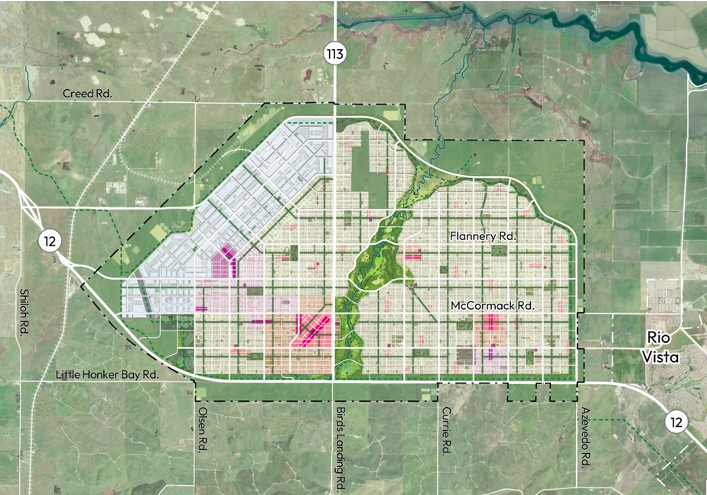
Source: California Forever (California Forever, n.d.-a) [2]
Rather than seeking broad countywide authorization before resolving key questions, the project now appears to be moving through more traditional planning, environmental review, and governmental processes. That path may be slower, but it also creates additional opportunities to evaluate infrastructure requirements, environmental impacts, public-service responsibilities, financing, and mitigation while expanding public and intergovernmental participation.
The experience to date also suggests that progress may increasingly depend on incremental work rather than major announcements: collaborative analysis of project impacts, building consensus around mitigation and infrastructure, negotiating implementation agreements, and continued coalition building. Stronger working relationships with local governments, agricultural interests, regional agencies, neighboring communities, and county officials could gradually convert the project's considerable private planning accomplishments into broader institutional support.
A municipal framework may also help clarify some of the governance questions that complicated the earlier countywide initiative. Municipal planning processes, potential annexation arrangements, service-delivery agreements, and development agreements provide mechanisms to evaluate, negotiate, phase, and manage growth over time.
Significant challenges would remain. Environmental review, infrastructure financing, water supply, transportation investment, economic-development objectives, and long-term governance arrangements will continue to require scrutiny. A community at the scale envisioned by California Forever will require not only substantial financial capital and regulatory approvals but sustained public confidence over a development period that could span decades.
Whether California Forever ultimately succeeds may therefore depend less on the ambition of its vision than on its ability to translate a privately assembled landholding and sophisticated private plan into a broadly supported public-private development program. Durable partnerships, resolution of outstanding concerns, and increasing alignment between the project's objectives and those of surrounding communities and institutions could ultimately provide the legitimacy necessary to move from vision to implementation.
References
Bandlamudi, A. (2025, July 17). California Forever wants to build a manufacturing town. KQED. https://www.kqed.org/news/12048321/california-forever-wants-to-build-a-manufacturing-town
California Forever. (2024, October 29). Our letter to the Solano County administrator re: Timeline. https://solano.californiaforever.com/our-letter-to-the-solano-county-administrator-re-the-timeline-of-the-east-solano-plan/
California Forever. (n.d.-a). Maps and diagrams. Retrieved October 3, 2026, from https://californiaforever.com/press-kit/maps/
California Forever. (n.d.-b). Solano Shipyard. Retrieved August 30, 2026, from https://californiaforever.com/shipyard/
Cooke, R. (2024, July 22). California Forever pulls ballot measure, plans for 2026 comeback. KTVU. https://www.ktvu.com/news/california-forever-pulls-ballot-measure-plans-2026-comeback
Dougherty, C., & Griffith, E. (2023, August 25). The Silicon Valley elite who want to build a city from scratch. The New York Times. https://www.nytimes.com/2023/08/25/business/land-purchases-solano-county.html
Dutta Gupta, T. (2026, August 25). Last-minute California Forever shipyard bill gets kicked to 2027. Bay Nature. https://baynature.org/2026/08/25/conservation/policy/another-last-minute-california-forever-shipyard-bill-goes-to-solano-supervisors/
Irvine Historical Society. (n.d.). Master plan developed. https://irvinehistory.org/master-plan-developed/
Johnson, E. (2026, August 27). California Forever faces a setback. California Local. https://californialocal.com/localnews/statewide/ca/article/show/654868-california-forever-faces-a-setback/
Neilson, S., & Stiefel, E. (2023, September 12). New California city: Map shows exactly how tech elites bought up land in Solano County. San Francisco Chronicle. https://www.sfchronicle.com/projects/2023/solano-city-map/
Oliver, H. P., & Stockstill, C. M. (2026, May 25). Déjà vu in new towns: Irvine’s past, California Forever’s present. Transforming the Irvine Ranch. https://thebigplanbook.com/blog/dj-vu-in-new-towns-irvines-past-california-forevers-present
Rosenthal, J. (1971, December 26). A tale of one city. The New York Times. https://www.nytimes.com/1971/12/26/archives/a-tale-of-one-city-a-tale-of-one-city.html
Sierra, S., & ABC7 Bay Area Digital Staff. (2024, July 22). Measure for new Solano County city no longer on November ballot, officials say. ABC7 News. https://abc7news.com/post/california-forever-company-planning-build-new-city-solano/15082222/
Solano County Registrar of Voters. (n.d.). East Solano Plan / supporting documents. Retrieved August 30, 2026, from https://www.solanocounty.gov/government/registrar-voters/historic-election-results-files/november-5-2024-general-election-results/east-solano-plan-supporting-documents
Sramek, J. (n.d.). Jan Sramek - Founder & CEO, California Forever [LinkedIn profile]. LinkedIn. Retrieved September 3, 2026, from https://www.linkedin.com/in/jansramek/
Sumagaysay, L., & Christopher, B. (2024, February 22). Tech-billionaire promises for a new city, from roads to water, are worth hundreds of millions of dollars—if they’re binding. CalMatters. https://calmatters.org/economy/2024/02/california-forever-promises/
University of California, Irvine. (n.d.). The City of Irvine. UCI Special Collections & Archives. https://special.lib.uci.edu/collections/anteater-chronicles/community/the-city-of-irvine
Wolffe, K., & Yu, Y. S. (2026a, August 19). Inside California Forever’s high-pressure push to fast-track a shipyard. CalMatters. https://calmatters.org/politics/2026/08/california-forever-shipyard-pressure-campaign/
Wolffe, K., & Yu, Y. S. (2026b, August 26). Surprise Solano County vote kills California Forever’s shipyard bill for this year. CapRadio. https://www.capradio.org/articles/2026/08/26/surprise-solano-county-vote-kills-california-forevers-shipyard-bill-for-this-year/
Wong, E. X. (2024, September 17). The California Forever debate moves underground. High Country News. https://www.hcn.org/articles/the-california-forever-debate-moves-underground/
Endnotes
1. Supporters cited in the draft plan included the Napa-Solano Building Trades Council, Northern California Carpenters Union, California YIMBY, California Building Industry Association, Governor’s Office of Business and Economic Development (GO-Biz), and Governor Gavin Newsom.
2. The draft plan identified California Forever CEO Jan Sramek and Head of Planning Gabe Metcalf as directly involved in creating the plan, with support from SITELAB Urban Studio, CMG Landscape Architecture, CAW Architects, HPA, and Steinberg Hart. It also listed ENGEO, Carlson Barbee & Gibson, EKI Environment & Water, Fehr & Peers, Mark Thomas, WSP, Introba, Dudek, JLL, CBRE, Economic & Planning Systems, DPFG, Holland & Knight, Perkins Coie, and Best Best & Krieger among engineering, environmental, real estate, financing, and legal contributors.